
Jewish for Palestine
Or not Jewish at all.
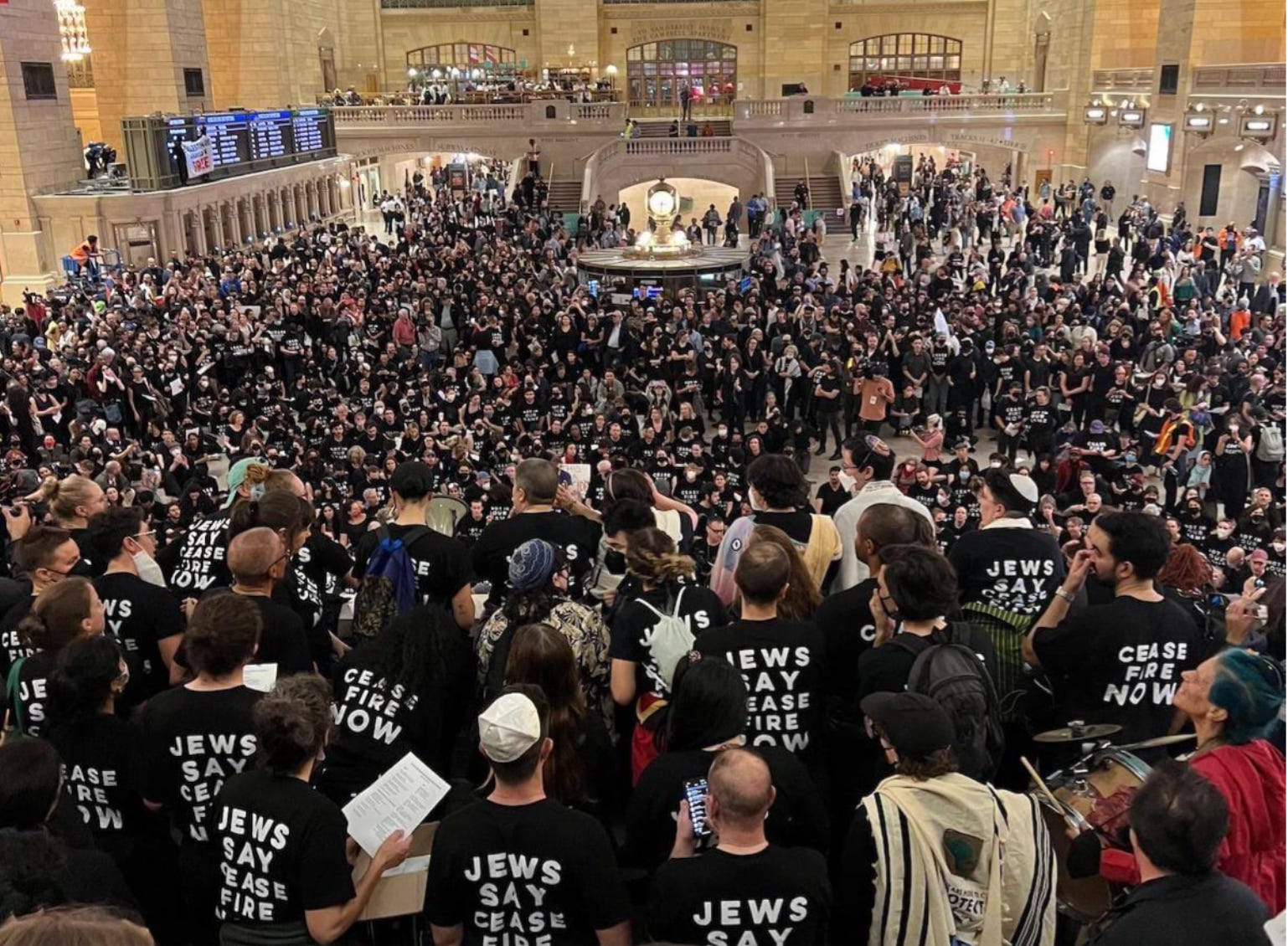
One of my kids is involved at school with a group called Jews for Palestine. The name is commonly shortened to J4P, which is totally normal but had our family cracking up on one of our Sunday night calls.
Firstly because J4P sounds like Gay 4 P, which is silly and juvenile but also, to anyone familiar with this movement, pretty funny because of how many people who, in all senses of the word, are super gay for Palestine.
But we were also laughing about the middle part of J4P, the ambiguity lurking inside a seemingly innocuous preposition. Jews For Palestine presumably means “We are J who support P.” But for some of us, it might also mean “The reason we are J is to better support P.”
If a Jew is only Jewish for Palestine, are they really a Jew? I wrote this piece over Hannukah, a holiday whose first day I rarely remember until a non-Jewish friend or student wishes me a happy one. I wrote it as I went shopping with my non-Jewish wife for a Christmas tree to put in her mother’s apartment.
For years, I’ve half-seriously compared myself to Brian Cranston’s goy dentist on Seinfeld, who loves telling corny Jewish jokes so much that he actually converts to give himself cover. Just like Jerry is offended that Dr. Watley has only become Jewish “for the jokes”, I like to imagine some other Jews complaining that the only reason I’ve only stayed Jewish for the protests.
I should clarify (not that opponents would notice or care) that I’m speaking only for myself. As a member of Jewish Voices for Peace, I’ve met many organizers, especially younger ones, who are deeply engaged in Jewish religious and cultural practices. But I’ll bet many of them can still relate to this essay. After all, it’s extremely Jewish to joke about not knowing exactly what is it that we are J for. To borrow my friend Sherry’s joke, even our suffix connotes ambivalence: we are Jew…-ish.
Most of us have at one point struggled to answer why we call ourselves Jewish if we’re not religious. After all, the perplexed questioner says, I don’t call myself Christian just because my parents went to church. Well yes, we haltingly respond, but it’s different….Jewish doesn’t mean religion…I mean it does, obviously…but not for me…well yes, more like an ethnicity…but not really…–until we find a way to end the interrogation by implying that these understandable questions are possibly antisemitic.
The awkwardness goes back at least two hundred years. In medieval Europe, Jewishness was often defined in the meaning people found through survival and persistence in the face of being demonized and occasionally terrorized by the dominant Christian civilization. (There’s a different history in the Muslim world, one I don’t know yet enough about to integrate into this narrative). That changed in the 19th century, when Napoleonic reforms granted Jews legal equality across much of Europe. Along with Emancipation came an existential question that comes with modern freedom: now that we have a choice in the matter, what exactly are we Jewish for? Unsurprisingly to anyone who has met us, we’re still arguing about it.
J4P or JINO?
Today’s debates over Jewish meaning increasingly take the form of which side you’re on in the Middle East. There are far more Jews for I than for P, but the pro-Palestine side is rapidly growing among young people and liberals–to the point that we can no longer be ignored. Instead, we are now redefined as simply not Jewish. Check out the comments of a pro-Israel publication or Facebook group, and you’ll encounter delusional groupthink that Palestine solidarity groups like JVP and If Not Now are filled with people pretending to be Jewish, with only a handful of token Jews acting as figureheads.
The more sophisticated form of this argument is that, yes, we’re actually Jews, but also no, we’re not. Reform Rabbi Wendy Geffen warns that anti-Zionist Jews are “Jews in name only” (JINOs!) who shouldn’t be allowed in the “big tent” of the Jewish community. As a demonstration of the size of this tent that somehow can’t include people who believe in peace, equality, and justice for Palestinians, the liberal Chicago rabbi says that her sermon is inspired by the hard-right Israeli Zionist Natan Sharanksy, who earlier that year coined, alongside co-author Gil Troy, an even more Orwellian term for us: The Un-Jews.
What do I say to these accusations? Am I a Jew primarily for Palestine? Perhaps. Does that make me a JINO? Not at all.
I wouldn’t go so far as to claim that Israel’s crimes are an affront to particularly Jewish beliefs–I’m pretty sure thou shalt not mass murder is a commandment common to all creeds and kinds–but they certainly violate the values I absorbed from my liberal Jewish upbringing–occasionally at my temple, more fully from my family. Those values went something like this: “Never Again” means for anyone, not just Jews; if there is a meaning to be drawn from the long history of Jewish persecution, it is that we should be leaders in the fight for a world where nobody has to face expulsion, persecution, and genocide.
I’ve been thinking about these ethics since I read Benjamin Balthaser’s new Citizens of the Whole World: Anti-Zionism and the Cultures of the American Jewish Left, in particular the chapter about the mid-century American Jewish liberalism that persisted into my 1980s suburban childhood. This liberalism, defined by a broad (and maybe not deep) politics of anti-racism and universal humanism, was created in no small part by secular Jewish Americans, for whom it became a defining element of what it meant to be both American and Jewish.
Balthaser argues that this distinct cultural and political history is the reason why–while later generations of Irish (and Italian, Polish, etc) Americans became White, as Noel Ignatiev put it–Jews became White Liberals. This American/Jewish/liberal culture was broadly supportive of Israel (as opposed to the Jewish anti-Zionist leftist tradition that is the main focus of the book), but it didn’t strongly identify with it, much less define it as the primary purpose of being Jewish.
Most liberal Jews of my generation didn’t become anti-Zionist. I probably ended up different because of my very close relationship in high school with someone who lived in Beirut as a 7-year-old during Israel’s horrific 1982 invasion. My relationship with her and her family changed my perspective of Israel, which I now saw not only as the place where my great-aunt found refuge after surviving Auschwitz but also as the cruel power that almost killed people I loved.
I don’t recall this shift being particularly troubling. There was no dramatic epiphany in which I “broke” with Zionism” because I never had a bond with Israel that was solid enough to shatter. Nor did I feel any particular disorientation when, a few years later in college, a socialist group recruited me to anti-Zionism as a part of an anti-imperial worldview. Don’t get me wrong, opposing Israel led to many painful arguments with family members–especially early on when I could barely defend my stance. But part of my frustration came from the fact that supporting Palestine seemed like a logical extension of the worldview they had instilled in me.
When accusations of antisemitism are weaponized against the Palestine solidarity movement today, they are able to draw on the fact that many Jewish Zionists truly experience protests against Israel as attacks on their Jewish identity. I want to respond to them with empathy, but I’m angry they can’t see how their reactions are symptomatic of the damage that Zionist monoculture has done to the different Jewish identity I remember.
“Un-Jews” or “Non-Jewish Jews”?
These other Jewish identities, both the liberal one I grew up with and the leftism I now practice, is all-embracing rather than tribal or religious, based in humanism rather than blood and soil nationalism. Which, I’ll admit, poses some problems. What does it mean to claim a Jewish identity that’s not particularly Jewish?
Fortunately for my case, this is a longstanding Jewish contradiction. Citizens of the Whole World directed me to “The Non-Jewish Jew”, a 1960s essay by the Marxist scholar Isaac Deutscher, who grew up in religious Polish home before becoming an atheist writer, first as a renowned Yiddish poet, then a leader of the Polish Communist party, and finally as that trifecta of antisemetic dog whistles: a globalist Trotskyist intellectual.
“The Non-Jewish Jew” analyzes some of the great minds of modern European history–including Spinoza, Marx, Luxemburg, and Freud–as part of a long tradition of “the Jewish heretic who transcends Jewry.” Deutscher argues that though their intellectual achievements pushed them beyond the bounds of Judaism, their unique insights stemmed from their Jewish positionality, being “in society and yet not in it, of it and yet not of it….Their manner of thinking is dialectical, because, living on the borderlines of national and religions, they see society in a state of flux.”
Written in the shadow of the Nazi Holocaust, “The Non-Jewish Jew” reluctantly concedes Israel’s necessary because “the world had compelled the Jew to embrace the nation-state,” but concludes with the hope that:
the Jews will ultimately become aware–or regain the awareness–of inadequacy of the nation-state and that they will find their way back to the moral and political heritage that the genius of the Jews who have gone beyond Jewry has left us–the message of universal human emancipation.
Deutscher’s essay was written just a few months before Israel’s 1967 Six-Day War; the ensuing surge of triumphalism and nationalist pride among Jews in both Israel and America pushed his universalism to the fringes of Jewish culture for decades. Now it’s making a comeback, and being denounced for the very ideals that Deutscher wrote about with pride.
This excerpt from Sharansky’s and Troy’s “The Un-Jews”, for example, reads as if “The Non-Jewish Jew” was run through Grok after one of Elon’s more manically McCarthyist algorithm adjustments:
For many of these un-Jews, the public and communal staging of their anti-Israeli and anti-Zionist beliefs appears to be the badge of a superior form of Judaism, stripped of its unsavory and unethical “ethnocentric” and “colonialist” baggage…these anti-Zionists join a long history of such un-Jews, who wormed their way deep into the tradition and tried to weaken Jewish identity ideologically from within by canceling a central pillar of contemporary Jewish identity, as part of what they imagine to be a wider commitment to world liberation. This phenomenon of the un-Jews has emerged most dramatically whenever Jews sought to join with non-Jews in advancing quintessentially Jewish ideas of brotherly love, equality, and social justice, unmoored from their Jewish context and their Jewish delivery systems (historically, the most successful of these un-Jewish movements being Christianity).
As Jewish intellectuals, Sharansky and Gill are well aware that the universalist Jews are not a recent phenomenon, that we are a part of the Jewish tradition. But, like all hard nationalists, their Jewishness is a monoculture; disagree with them and you’re not really Jewish (undermining the “my people right or wrong” ethos is the nationalism’s false promise). Sneering at dialectical pretensions like “non-Jewish Jews”, they rely on the blunt force of expulsion: We are either Jews like them or not Jews. They will un-Jew us.
Antisemitism and Philosemitism
Is there validity to the fear that non-Jewish Jews are weakening the Jewish community? I suppose so. What I would call our nonsectarian commitment to contribute our Jew…-ish worldview to all of humanity, you might dismiss as mere assimilation.
Fortunately, and I use that word in the most ironically Jewish way imaginable, the demonization of Jews embedded deep in the Christian West has prevented assimilation from ever getting too far. In the two centuries since legal emancipation in Europe, the process of Jewish dilution into the mainstream culture has been dramatically arrested by spasms of antisemitism. (These spasms have real historical causes– antisemitism isn’t an inherent human condition–but that’s not the focus of this essay.)
The result is that we’ve never figured out what we’re Jewish for, because at some point a different answer is imposed on us: you’re still Jewish because we still hate you because you’re still Jewish. In the face of this paradox, the identity that many Jews have embraced is best summarized by the classic Groucho Marx joke about refusing to join any club that would have him as a member.
Up until the last decade, I never would have imagined myself writing this essay. As a white middle class American born in the second half of the 20th century, I experienced a golden age of Jewish safety and prosperity in a Christian society (we generally fared better in Muslim ones). As a grandchild of Holocaust survivors, I was always going to “feel” Jewish, but that didn’t stop me from raising my kids outside of a temple or organized Jewish community. I would sometimes feel a mild touch of regret that they would probably not end up being Jewish.
I no longer think that. Granted, they are both young people with evolving identities, but they, like me, are moving towards more strongly identifying as Jewish. Yes, one reason is probably that their Dad is much cooler than their Mom, but it’s more than that. The homicidal targeting of Jews was something I learned about through the stories of my grandparents, but not something I saw happening in Pittsburgh synagogues or Sydney beaches. Growing up, I was taunted by an antisemitic slur twice (yes, I remember both occasions); my kids have likely seen dozens of Nazi rants online. I’m not sure if any of this makes them feel personally targeted, or think of me or their Jewish grandparents, but I’m sure it registers on some level that’s personal.
Mostly, however, I’m pretty sure the driving force in their growing Jewish identity is the same as mine: support for Palestine and rebelling against the imposition of Israel as the mandatory team for all Jews to root for. As young left wing people, they would support Palestine whether or not they were Jewish. But support for Palestine is making them more explicitly Jewish, not just for the moral high ground it allows them to claim, but because–through me and independently of me–they feel the same anger that I do about the erasure of anti-Zionist Jews. And the same fear of the ominous implications of Christian nationalists arming a genocide and cracking down those who protest–in the name of protecting Jews.
I teach at a public university that has cracked down on any expression of support for Palestine. I do my best to support these protests, but I have to act cautiously because I, a Jewish adjunct lecturer with almost no labor rights, could be effortlessly fired by my non-Jewish bosses, acting under pressure from Christian nationalist politicians–on the grounds that I am antisemitic.
What does one call this situation? Every word I can think of–gaslighting, hypocrisy, audacity–only covers a fraction of the infuriating absurdity. There should be one of those long German words to indicate antisemitism-through-fake-antisemitism.
Actually there is an appropriate long German word: philosemitism. The “admiration” for Jews that we have long warily encountered: You people are so good with money! Why can’t we be more like the Jews? They really know how to stick together! Philosemitism, as an old joke puts it, is the expression of antisemites who love Jews.
The Ongoing Weirdness of Being Jewish
The more that Israel’s relentless war on Palestinian people becomes a defining political fault line across the US and Europe, the more our world resembles a philosemitic satire of an earlier era.
The historian (and Holocaust survivor) Hannah Arendt famously called antisemitism “an outrage to common sense”--not just the stupidity of its ideas but the ludicrous but true fact that hatred of Jews–a tiny minority of Europe’s population–could snowball into the global chaos of fascism, global war, and genocide. Today, common sense should also be outraged at the idea that the US has fully armed a livestreamed genocide, and supported an expanding war that has no clear aim into Iran, Syria, Lebanon, and Yemen–deeply unpopular policies that has thrown universities, civil society, and now both political parties into chaos–all because of its ironclad allegiance to a tiny Jewish ethnostate.
The only reason this isn’t more widely seen as nonsensical is that we are so thoroughly steeped in the philosemitic ideology of American Zionism (an alliance of evangelical Christianity and the Pentagon with pro-Israel Jews), laid over classic antisemitic insinuations of hidden Jewish power. There is no creepier strain of philosemitism than Christian Zionism, the centuries old Protestant tradition that has called for Jews to “return” to Israel as part of Biblical prophecy to bring about the Second Coming (and conveniently to get Jews out of their own countries). There is no more menacing strain of philosemitism than the US war machine, which has developed a deep admiration for both Israel’s high tech settler surveillance state, and the widespread political support its leaders have garnered for permanent war (while loathing the still Jewish-coded leftist intellectuals and international solidarity activists.)
All of which means that, despite the hopes of early Zionists that a nation-state would finally make Jews normal, we remain deeply weird. From the era of antisemitism to philosemitism, we retain the uncanny experience of being cast as the stars of other people’s political and religious fantasies. This weirdness is another reason why I think my even more non-Jewish Jewish children will probably remain Jewish, and that they might struggle to explain why even more than I have over these past three thousand words.
Speaking of wasted words, I should note in conclusion that it doesn’t really matter why we’re Jewish. As long as Palestinians are being starved and slaughtered in our name, J for P will milk our Jewishness for all its worth to expose the lie of USA for J: the lie that this increasingly deranged Christian nationalist empire actually cares about Jewish safety rather than the three insidious I’s: Israel, Islamophobia, and Imperialism.
As we move deeper into dangerous times that demand global collaboration and sacrifice, when too many people are being pulled in the opposite direction towards nationalistic ignorance and blood lust, I hope people can find meaning and inspiration in large numbers of Jews rejecting the poisoned offer of imperial philosemitism and casting our lot with world’s majority. That’s what I’m going to be J for. I’m Jewish for Palestine, because I’m Jewish for everyone.
What an excellent article..thank you for giving us hope that there is sanity left after all and sorry that you have to go through this weird identity crisis just for the world to recognize that humanity matters most
As a Christian raised individual, I appreciate the perspective and education in your essay. IMO we need P4P -- People for Palestine -- regardless of their religious faith and practices.
Keep up the good fight, comrade and peace to you and yours.