
Capitalist Unrealism
There is no alternative to AI bullshit
Donald Trump’s greatest power was, and I’m using the past tense for a reason, his ability to live in his own awful reality and then impose it on the rest of us. For most of the last decade, he’s been able to shamble his way through bold lies, disastrous policies, and revolting behavior that would sink any other public figure, and end up creating the meaner, dumber world that nobody wanted.
Now, just when plummeting polls and Republican defections indicate that Trump has finally returned to being subject to basic laws of cause and effect, the AI oligarchs seem to have inherited his power to make reality whatever THEY say it is.
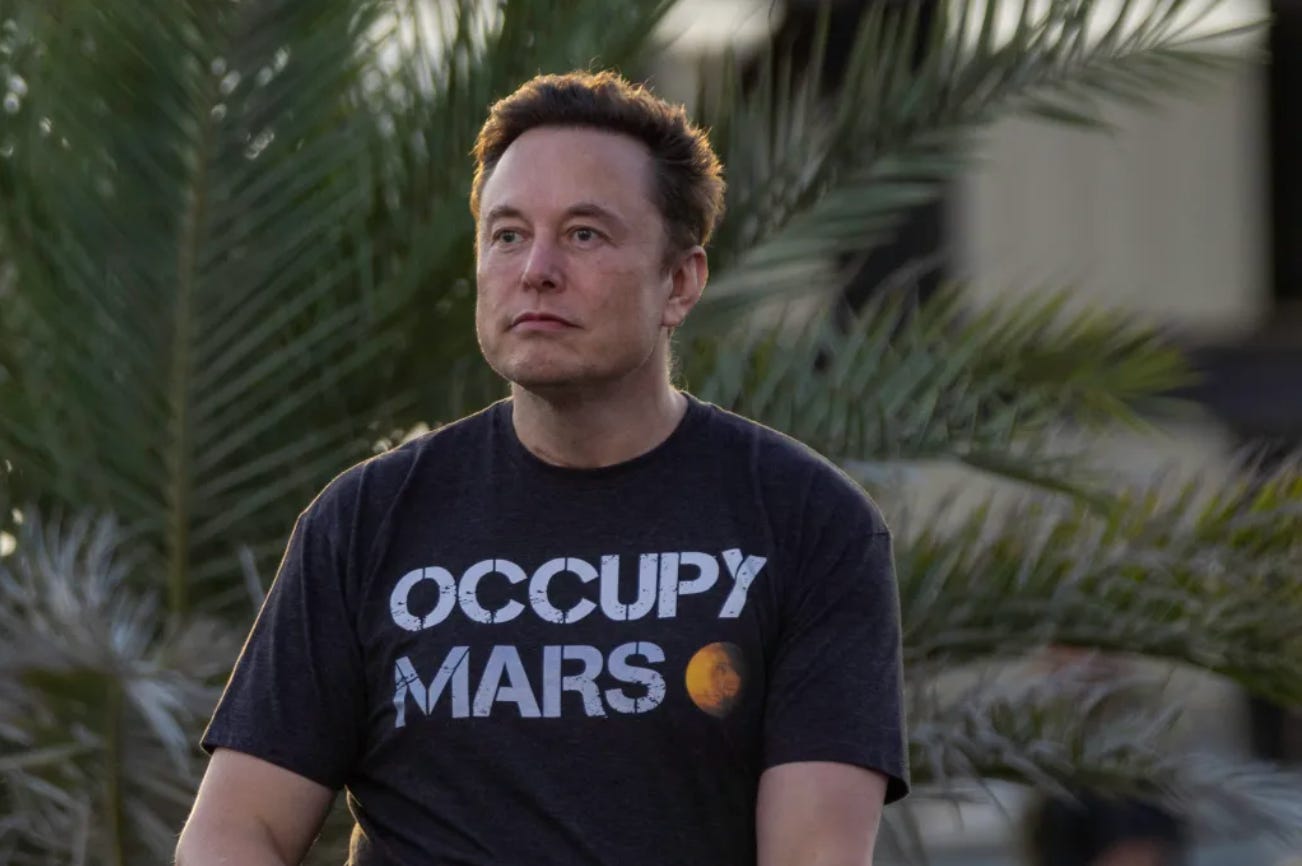
Elon Musk, you may have heard, became a trillionaire (maybe) after the IPO of his company SpaceX. In the company’s SEC filing for SpaceX, Musk pledged “to harness the Sun to power a truth-seeking artificial intelligence that advances scientific discovery, and ultimately to build a base on the Moon and cities on other planets.”
Do SpaceX investors, including the ones who may run your pension fund, actually think they are getting into the business of Mars colonization? No, what they know is that investing in Musk has been profitable, regardless of what his companies have actually done. The fact that most of his wild promises don’t come true is not a flaw in his business model but an essential element of it. As Henry Farrell puts it, “propagating a mythology of the future that is in fact a promissory note that you can turn into financial and political capital today.”
Farrell’s post is a review of Muskism, a book I look forward to reading over the summer. Authors Quinn Slobodian and Ben Tarnoff write that throughout his career, Elon has “spun persuasive science fictions to win the confidence of his investors.” The AI bubble, which is not only financial but epistemic, should make us question a premise shared by most of us – from Marxists and free market ideologues – that there is an underlying logic to capitalism, a tangible source of value underneath the hypes and hysterias. The implications of this question are more profound for humanity’s future than any chain of words that’s come out of ChatGPT.
While Elon was preparing his company’s psychedelic IPO, his rivals at Anthropic were performing their dystopian version of the same con. The company has been gaining ground on its competitors both because of user satisfaction with its Claude model and its wildly successful branding campaign as an ethical AI alternative – which mainly consists of CEO Dario Amodei repeatedly issuing dire warnings about the technology his company keeps right on producing.
The excellent tech journalist Brian Merchant recently recounted the success of Anthopic’s most recent round of this doom marketing:
After sparking a major news cycle in the tech media with its April announcement that it had built an AI model, Mythos, so powerful, so dangerous that it threatened to upend the entire civilizational order—and that it was diligently withholding the product from the public so as to protect us from it—the nation’s now-#1 AI startup decided to put Mythos up for sale after all.
Apparently two months’ of protection from the ultra-AI is all the safeguarding we needed. Interestingly, that’s precisely the amount of time that it took Anthropic to translate the press attention around Mythos into a historic $65 billion funding round. What a coincidence. According to its marketing materials, Anthropic’s Claude Fable 5, is a “Mythos-class model” that has been “made safe for general use,” and will be on offer to “organizations taking on their hardest knowledge and coding work.” It’s available now “on the consumption-based Enterprise plan.”
It’s hard for me to exaggerate how shameless this is. Has there ever been a more successful marketing campaign, one that yielded so many billions of investment in so short a time? The Mythos campaign is nothing less than the ne plus ultra of AI ‘doom marketing’, the practice that has helped animate the entire AI boom, and that sees tech companies drum up investor and media interest in their products by registering harrowing claims about the threats those products pose to jobs, norms, even humanity’s very existence.
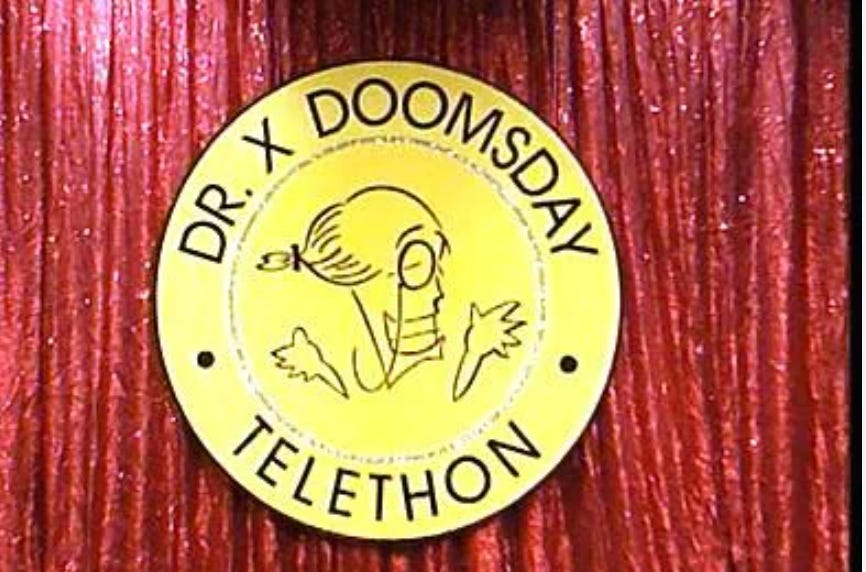
There’s an old Mr. Show sketch called The Dr. X Annual Save the Earth Telethon. An evil scientist hosts a cheesy televised fundraiser to pay ransom to prevent him from destroying the planet with his doomsday space laser. The best moment is when an adorable little boy is given the microphone and says, “Please don’t kill me,” “Aw, you see zees is why I do zees,” says Dr. X as he turns to the camera. “For ze kids.”
A wonderfully silly sketch in 1997 has become an embarrassingly effective business model in 2026.
But wait a second, hasn’t AI produced actual technological advances? Of course. How could it be otherwise when unprecedented amounts of capital are poured year after year into research and development? Decades of neoliberalism created vast pools of wealth in the investor class, now impatient with small and steady profits and eager for literal moonshot gambles on farfetched technologies. Those massive investments (and massive theft) enabled tech companies to buy enough computing power and research talent to create Large Language Models (LLMs) to a scale that have produced some genuinely startling results.
In the excellent Empire of AI, a Chinese researcher tells author Karen Hao that AI could only have originated in America, not because of its superior technology or personnel but because Chinese researchers couldn’t have raised billions of funds investment without “an articulated vision of exactly what it would look like and what it would be good for.”
Of course, most of us could have articulated visions of what trillions of dollars would be good for – cancer cures, renewable energy infrastructure, and (not or) ending world hunger – but that’s a fantasy, isn’t it? Let’s stay focused on what’s realistic, like space colonies. Hao writes that “the tech industry could profess big bold visions about changing the world and building a better future while ignoring the very problems at its door,” noting the “utter contradiction of declaring the problem of creating and managing beneficial AGI possible, but San Francisco’s housing crisis too tough to tackle.”
LLMs have clearly achieved breakthroughs in the automation of writing and coding, among other tasks – and some of these achievements raise real and disconcerting questions about the future of these fields, as well as how we will understand “intelligence” moving forward. But there’s nothing profound about the current AI discourse driven by industry hype and a grim ruling class desire to replace its mortal labor force with obedient code.
Ted Chiang makes a clear distinction between what’s actually impressive about LLMs and what’s utter bullshit. Responding to Amodei’s claim that Claude might in fact be “conscious”, Chiang writes:
It’s not plausible to me that a development path where the first step is a sentence-continuation machine that emits bad Julius Caesar dialogue and the next step is a sentence-continuation machine that emits decent Julius Caesar dialogue is one with a conscious Julius Caesar—or consciousness of any sort—as its end point. Faking the moon landing is a good step toward faking a Mars colony, but it’s not a good step toward actually putting astronauts on Mars.
Chiang is a great science fiction writer with a longstanding fascination with language, as anyone who’s read or watched Arrival knows. The science fiction of artists like Chiang presents us with alternate realities that give us new perspectives on the one we’re actually in. This new science fiction of capitalists does the opposite. They demand we accept an alternate reality in which they will always be in charge because they determine what’s real.
Over a decade ago, Mark Fisher famously coined the term capitalist realism to describe the way that decades of neoliberalism had made hegemonic the idea that THERE IS NO ALTERNATIVE to the increasingly depressing societies of Western capitalism. We seem to have now passed into capitalist unrealism.
Early Silicon Valley was shaped by 1960s counterculture: half a century later it has turned an iconic slogan of 1968 into an authoritarian dictate: Be realistic: accept the impossible. Sentient algorithms are the inevitable reality, and anyone who disagrees is a reckless daydreamer.
I’m wondering if this has something to do with the pragmatic nature of our social democratic moment, where leftists are succeeding by combining radical energy behind some pretty moderate policy ideas. If you’re an Overton Window type, and I kind of am, it doesn’t bode well to see the left being so moderate while the right is so extreme.
But maybe the left can take advantage of our opponents abandoning the terrain of reality. As billionaires become trillionaires on a dangerous bubble that relies on mass delusion, it’s becoming subversive to simply insist that up is up and not down. We can build a wider base for socialism not just through inspiring but distant visions of a better world, but a common sense vision of this one.
I’m not talking about pedantic “fact-checking.” I’m talking about asserting obvious truths: machines are not human; nobody wants data centers stealing their water and raising their electric bills; access to health care saves lives. I’m talking about being unrealistic, perhaps even revolutionary, and demanding what is so obviously possible.
Very scary!
You’ll appreciate this video by a lefty sci-fi expert:
https://youtu.be/WNiSUGCC-gY